The purpose of value investing is to always buy bargain issues. I saw a good opportunity to purchase a company I believe was undervalued in the market. That company was Nintendo (NTDOY).
I purchased shares of this company at two different times. The first of which was effected by speculation, so the stock price was pretty high. It was prior to the release of new product (the Wii U) which made the share prices sell at higher prices (15.96 per share, 32 shares purchased). I purchased about a week before it was released. Being a novice investor, I now realize I got caught up in the excitement of a new product. I now know not to get caught up in speculative upswings based on unrealized future potential. Sales of the Wii U have not done too well (I am not writing off the product though). Caution is advised when purchasing a company before the release of a new product. We as investors have no idea how people will react to a new product especially a consumer good product (something that people don’t necessarily need but have for enjoyment purposes).
The other time I purchased was when the share price was hovering around an extremely low price (11.52 per share, 33 shares purchased). If I remember correctly, this was from negative sentiment from the Wii U after being released. Not many consoles were sold and software companies were abandoning the Wii U platform such as EA. This was a great time to purchase more shares of the company to help bring down the average price I paid for the shares.
Taking into account the shares purchased, the average price is 13.86 per share. This is a simple strategy known as dollar-cost-averaging. You buy into a company more than once, so it seems like an overall better buy (some people do it at arbitrary times — I decided to wait until the price was extremely low) and a safer one. This strategy makes an investor buy stocks at high and low prices. I sometimes think this when I buy gas. I don’t really squabble about the small changes in the price of gas because it will average itself out eventually. The only issue with this strategy is having excess cash laying around. The risk of holding cash is the risk of inflation and the opportunity cost of holding cash. I could get a better return while investing or doing something else with my money, instead of holding it as cash.
A couple of things came to mind while I sat on the shares I had purchased. When is a good time or price to sell the shares at? Should I try to time the sell before a quarterly report which may have more good news or bad news? How long will I hold this company?
The notion that the stock market is motivated by greed helped me determine my time to sell the shares I owned. I sold them at a price of 18.21 right after a speculative upswing in the market sent the shares soaring. This gave me a return of 31.42 percent return before taxes and commission. News was released that China was opening up trade for game consoles (Microsoft, Sony, and Nintendo all have a vested interest in this news). Hearing the good news, I figured it was a good time to sell. Nothing about the underlying business of Nintendo has changed, it just felt like a good time to sell.
A couple other ideas came up why I sold them. How is the market for video game consoles in China? I looked at this issue marginally, having read bits of information while keeping up with Nintendo for a year. Basically, video game piracy is pretty rampant in China. This tells me that video game makers (but more importantly software developers) may have a difficult time making profits in this market (because video games can be pirated at zero cost to consumers –> business makes no money). Knowing this and how Nintendo’s business operates, this news doesn’t really present too much opportunity or justify a huge upward price swing. Nintendo is a company that develops both hardware AND software. Software has always been used to drive console sales, but Nintendo software is always purchased at premium prices while maintaining higher than average sales. This reflects the strength of Nintendo’s golden egg: the strength of its franchises. One simple way to prove to someone the strength of Nintendo’s franchises is to look at the release date of a game made by Nintendo. Look at how long the video game has been on the market but also the price. Nintendo games stay artificially high for some reason, probably reflecting the strength of Nintendo franchises.
Nintendo always has a risk factor listed in its annual reports “Limitations of protecting intellectual property rights.” This is obviously an issue with selling video game consoles in China, especially for a company that relies so much on the strength of its franchises. It will take some time for video game makers and software producers to adapt to this market (the Chinese market is way different than the USA video game market).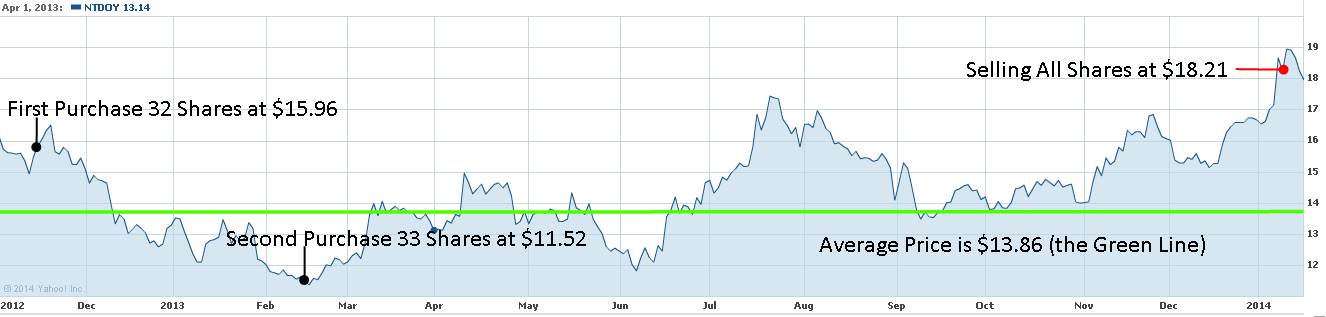
I will write more about Nintendo and some the of the other factors I looked for when I was holding the stock. There is plenty more about this company that is important to think about when investing. Today, the stock dropped about 16 percent due to some negative news. The graph doesn’t show that, but I’ll write a bit more about the news (possibly good news in the long run) in my next post. Nintendo’s underlying business may change, which may be a positive strategy which may signal another cheap buy. I’ll explain this later.

 Links:
Leave a comment